
All about skateboard bearings
In the following article you will learn everything you need to know about skateboard bearings.
What size are skateboard ball bearings?
Skateboard ball bearings are industry size 608, with an inner diameter of 8 millimeters, an outer diameter of 22 millimeters, and a width of 7 millimeters. These dimensions are standardized, so all available skateboard bearings will fit all conventional skateboards, provided you purchased the components from a specialist retailer.
Construction:
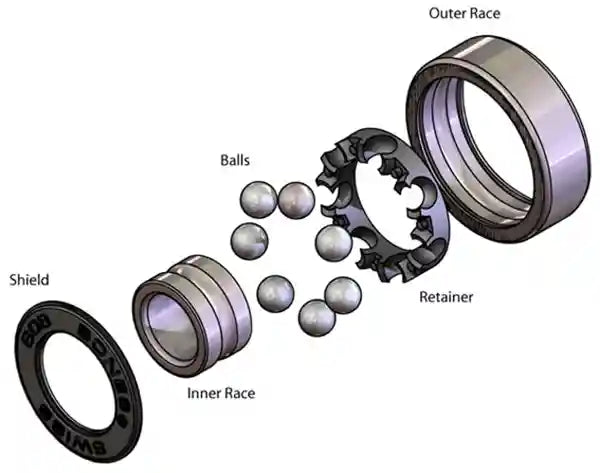
A skateboard ball bearing typically consists of 5 components:
• The shield: The shield's purpose is to keep dirt out. While often made of steel in the past, modern shields are now made of plastic. They are designed to have as little friction as possible. With high-quality bearings, the shields can be easily removed for better cleaning. Many skaters permanently remove their shields. It remains controversial whether this is a trend or whether it actually increases speed by running the bearings without shields. However, it is a fact that the bearings become somewhat louder, more dirt and foreign matter can penetrate them, and their lifespan is negatively affected.
• The balls: These are usually made of steel, with the exception of ceramic ball bearings. Seven balls are standard, but in recent years models with six, slightly larger balls have also become available. This is intended to reduce friction and thus provide more speed and a higher top speed.
• The cage: The cage keeps the balls in shape. In good brand-name ball bearings, it is made of Delrin. Delrin is a high-molecular-weight thermoplastic material characterized by high strength, hardness, and stiffness across a wide temperature range. It ensures that the balls run smoothly between the outer and inner rings.
• Inner and outer rings: Made of hardened steel to guarantee stability. They are equipped with grooves in which the balls run.
The following graphic shows the structure of a Bones ball bearing:
How many ABEC ratings do skateboard bearings need?
The only correct answer to this is: none at all. ABEC stands for "Annular Bearing Engineers Committee." It's an industry standard that indicates the precision with which bearings are manufactured. The ABEC scale ranges from 1, 3, 5, 7 to 9. Tolerances decrease from 1 to 9, meaning ABEC 9 runs more precisely than ABEC 1. Most skateboard bearing manufacturers offer bearings ranging from ABEC 3 to ABEC 7. That sounds pretty good, but the conventional purpose of a ball bearing in industry is to run as fast and smoothly as possible. Ball bearings are tested under conditions of 30,000 revolutions per minute, which would correspond to a speed of over 200 km/h on a skateboard. And let's be honest: nobody goes that fast. But what's much more important: skateboard ball bearings have completely different requirements than industrial ball bearings. Industrial bearings aren't designed for landing after a ten-step ollie. Skateboard bearings must withstand impacts, side blows, and other demands. They also have different requirements regarding maintenance and cleaning. That's why some of the most reputable skate companies no longer use ABEC ratings for their bearings, most notably Bones, Bronson, Cortina, etc.
Maintenance:
How do I maintain my ball bearings? The best way to ensure your ball bearings last as long as possible is to keep them away from dirt and moisture. It's also important to be clear: don't overdo it with maintenance. You don't need to lubricate your bearings every week. On the contrary, doing so every couple of months is usually perfectly sufficient. This minimizes internal friction and provides additional protection against corrosion and rust. Never use oily substances for this, as these often cause road grime to stick to the bearings and slowly seep through the bearings. There are lubricants specifically developed for skateboarding, such as those from Bones or Bronson.
Cleaning:
For cleaning the bearings, acetone is best. First, carefully remove the shields with a sharp, thin object such as a utility knife. Carefully insert the knife into the gap between the shield and the inner race of the ball bearing and gently pry it out. The shields must be removed before cleaning because the acetone can damage the plastic of the shields. After cleaning, you can wipe the bearings with a piece of paper towel and then lubricate them.
Your ball bearings should never get wet, as moisture has difficulty escaping and they will rust very quickly. If this does happen, you should disassemble them and dry them as soon as possible with a cloth or paper towel.
What types of skateboard ball bearings are there?
In addition to the standard bearings discussed so far, there are also Swiss, ceramic, and titanium bearings.
Genuine Swiss bearings are manufactured in Switzerland. They do not fundamentally differ from conventional bearings; however, Switzerland has always been known for its high quality, and the designation therefore serves as a mark of quality.
Ceramic bearings have balls made of ceramic. The material is harder and smoother, resulting in less friction in the grooves and making these bearings faster. However, the balls break more easily than steel balls upon hard impact, making them more suitable for ramp skating than street skating. Ceramic bearings also require more maintenance.
Titanium ball bearings are either made entirely of titanium, or only the balls are. Titanium is an extremely light and hard metal. Pure titanium is 45% lighter than steel and does not rust, making it less susceptible to moisture.
While they aren't part of the ball bearing assembly, some sets come with spacers. What are spacers for? Their purpose is to create a seamless connection between the ball bearings, thus increasing stability and lifespan. In practice, they are most useful in racing applications or with soft wheels that lack a hard core.
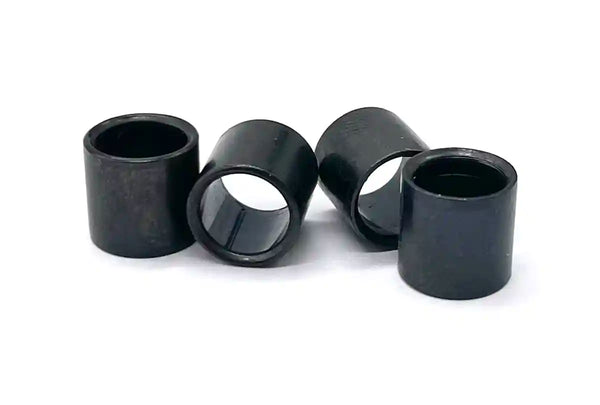
Washers: Also not part of the ball bearing, washers are shims that are placed between the inside of the axle and the axle nut. They ensure that the ball bearings rest directly against the inner races, thus preventing the bearings from rubbing against the axles.
We always carry a large selection of skate bearings; you can find our entire selection here .

